YEAR 6 HOME LEARNING 15/5/20
Welcome to another week of home learning for Year 6 pupils. The Year 6 Team are very proud of the commitment and effort you are putting in to this work whilst at home, where there are many other distractions to deal with. All of the tasks you are being provided with help maintain your achievements and progress over the year to date – so keep going!
Once again, focus on the maths, reading and writing first and then pick from some of the wider curriculum tasks 🙂 If you still have a task you would like to complete from last week – that is fine. Keep sending in one example of a piece of work you are proud of to the addresses below:
penguinclass@stpeterswaterlooville.hants.sch.uk
sealclass@stpeterswaterlooville.hants.sch.ukv
MATHS
This week we will be revising and deepening our understanding of: co-ordinates in all four quadrants, reflections and transaltions of shapes. Work through each task using the link. If you want to do a little more, there is an additional, ‘optional‘, task each day to test your understanding.
Following the close-fought TTRockstars Battle of the Bands tournament, you will be pleased that another has been set for this week. Will it be 2 in-a-row for 6P (in the lead at time of writing this), or will 6L make a comeback?!?
Monday /Task One
Click on the link below and work through Monday Lesson 1, Maths – To describe co-ordinate positions on a grid.
https://www.thenational.academy/year-6/maths/to-describe-coordinate-positions-on-a-grid-year-6-wk4-1
There are two extra questions here Task one explain co ordinates
Tuesday /Task Two
How did task one go? If you are ready to try task two – To translate simple shapes – click below:
https://www.thenational.academy/year-6/maths/to-translate-simple-shapes-year-6-wk4-2
If you would like to, work out what has gone wrong with this Task two explain translation mistakes
Wednesday / Task Three
Today’s lesson is – To reflect simple shapes in the x and y axis. Click below to enjoy.
https://www.thenational.academy/year-6/maths/to-reflect-simple-shapes-year-6-wk4-3#slide-1
You can work backwards to find the starting point for a reflection with this task Task 3 reflection reasoning
Thursday / Task Four
Task four requires you to – Solve practical coordinate problems. You will be able to use what you have revised/learnt this week to help. Click on the link below:
https://www.thenational.academy/year-6/maths/to-reflect-simple-shapes-year-6-wk4-3#slide-1
If you found that a breeze, there is more of a challenge here Task 4 co-ordinates reasoning
Friday / Task Five
It is Friday! Log in to MyMaths and complete the assessment quizzes that have been set. There is one for arithmetic and one for reasoning 🙂
Guided Reading (Grammar and Vocabulary too) (40 minutes per day)
Monday
1) Read the extract below and then answer the questions that follow.
An extract from Chapter One – Moodial, by Helen Cresswell
Even before she came to Belton, Minty Cane had known that she was a witch, or something very like it. She had known since she was tiny, for instance, about the pocket of cold air on the landing of the back stairs. She knew that other ‘happenings’ had taken place within the house she lived in. She did not talk about these things for the simple reason that they did not strike her as remarkable. Their appearance was as commonplace to her as that of the milkman. The only difference was that the milkman did not cause her spine to prickle.
Now, she and her mother were living in a different, smaller house, and her mother was working full time at the hospital. Minty would now come home from school and find the house empty. The weekends, once oases, were now deserts.
“And when it comes to the summer holidays, we shall have to do something about you,” her mother said.
“What?” demanded Minty. “Post me off somewhere like a parcel?”
“That’s an idea,” said Kate. “Registered, of course.”
In the end it was decided that Minty should spend the holidays in the village of Belton, and stay with Kate’s godmother, Mrs Bowyer.
Looking at the prologue of ‘Moondial’ and the start of Chapter One of ‘Moondial’
2) Skim and scan the ‘prologue’ again from last week’s learning (it can be found in last week’s blog).
Is the ‘tension’ and ‘mystery’ that is shown in the prologue kept up within chapter one above? How? Explain your thinking and use evidence from the TWO TEXTS to show HOW the two texts might or might not ‘sound’ and ‘feel’ similar when read.
3) Skim and scan chapter one above.
Where in the text does the atmosphere and setting of the story change?
Mark with a line where it changes.
4) Why did you mark this part of the text to show where the atmosphere and setting change?
THINK – what clues helped you think, “Ah, I can see that the atmosphere and mood of the writing changes at this point here in the text…”
Explain your choices and thinking.
Tuesday & Wednesday
Re-read chapter one above. Answer the questions below.
1) Did Minty think that the ‘happenings’ that had taken place in the house were ‘normal’ to her? Use evidence from the text to support your answer.
2) Did Minty think that the things she saw were scary? Use evidence from the text to support your answer.
3) Look at the paragraph beginning, “Now, she and her…”
What is meant by the phrase, “The weekends, once oases, were now deserts.” Explain.
4) So, what do you think the word, ‘oases’ means?
5) Minty was not impressed when her mother said what she would do with her in the summer holidays. Find the words in the text that show Minty was not impressed and quote the words only.
6) How do these words you chose show that she was not impressed?
Thursday
Reflecting on the use of dialogue within a chapter and its purpose
1) Look at the extract above from chapter one again.
Why might the writer have used dialogue after the opening paragraphs of the chapter? Give three possible reasons. (Think about what the job of the dialogue can do…)
2) How does the opening speech of the mother set the ‘tone’ of the dialogue that follows? Explain your thinking.
3) From the dialogue in the extract, do you think the mother and daughter have a good relationship? Why or why not? Use evidence from the dialogue in the text to support your answer. Use more than one piece of evidence to show your view.
4) The atmosphere, tension and mystery within the text changes once the dialogue starts. How does this dialogue change the atmosphere, tension and mystery? Explain.
5) Would Minty have wanted to go somewhere other than her house for the summer? How do you know? Use evidence from the text to support your view.
6) Did Minty like coming home from school to find the house empty? How do you know?
Friday
Read the continuation of the chapter below.
“You’ll like that,” Kate told her, and Minty agreed that she probably would.
Mrs Bowyer lived in an old stone cottage right opposite Belton House, which was golden and beautiful and had once belonged to Lord Brownlow. Now it was owned by the National Trust, and was open to visitors from April to October.
“I’ll get in free, I expect,” said Minty, “whenever I want to, with Aunt Mary working at the House, and that. What I’m dying to see is that secret tunnel.”
Task
Questions
1) “How does the house Mrs Bowyer lives in differ from the two houses Minty lived in before the summer holidays (at the start of chapter one)? How are they different from each other? Use the text as evidence to support your thinking in how they are different.”
2) Look at Friday’s extract above.
What impressions do you get of the experience Minty was going to have when she stayed with Mrs Bowyer? Give three impressions, using evidence from the text to support each impression.
(THINK about the opportunities Minty was going to have and her surroundings she was going to be living in and be around…)
Writing (50 minutes per day and only one task this week as Guided Reading is quite ‘meaty’)
Monday
Finish your sensory setting description from last Friday. If this only takes 10 mins then move on to Tuesday’s writing learning straight after.
Tuesday and Wednesday (Research and plan a Persuasive leaflet for Belton House)
Research Belton House, the setting for the opening of our Guided Reading book, Moondial.
Type into Google – ‘Belton House National Trust.’ Click on the first link available (https://www.nationaltrust.org.uk/belton-house).
Research information about Belton House and what is has to offer the public. As you research, choose three or so areas that your persuasive leaflet will focus on. (Writing about the directions and ‘How to get there’ WILL NOT hook me in and make me want to come really!!!)
THINK about what are the KEY things to be researching and looking for information about…(for example, what is there…Our cause…etc…etc)
On their website, they even have information about their Medieval Gardens and what these were used for during this period in British history! SO, if the Audience you are writing for like their history of Britain, then this could be very persuasive and capture their interest straight away!
Really THINK about who will be reading this and who your audience would and could be…families? People who like their history? People who like their nature and wildlife?
Really think about whether the notes you are making will really add VALUE to what you will write about next and whether the notes you make will tickle the interest of the reader.
Task for Thursday and Friday
WRITE your persuasive leaflet for Belton House!
Think about what sub-headings you will use and what persuasive language and techniques you will use to hook the reader. Think about the direct address to the reader and the use
ART CHALLENGE!
Art Challenge: UNDER THE SEA
The title for your art this week is ‘Under the Sea’. This can take the form of a drawing, a painting, a sculpture, a collage or anything else that you would like to create. As always, I’m sure you will impress me with your creativity!
Click the link for further details and inspiration – Under the Sea Art Challenge
Family Science Activity – Friday 15th May 2020
Balancing Structures
The activity – Make a balancing toy.
Experiment with the design of your toy to find out what affects whether or not it balances.
Learn about the centre of mass of an object and how it relates to whether or not something balances. https://www.rigb.org/docs/balancing_sculptures_infosheet_0_0.pdf – activity worksheet in full
What you need:
· A carrot or similar vegetable
• Kebab skewers
• Marshmallows and/or other jelly type sweets, or small pieces of carrot or similar hard vegetables.
• Plasticine or blu-tac
• 500ml soft drink bottle or washing up liquid bottle
Stage 1: Cut a piece of carrot about 3 cm long. Stick a kebab skewer into one end of the piece of carrot and break the skewer so that you have only 2 or 3 cm of it sticking out. Try to stand the carrot piece up on the end of the kebab skewer – you should find this very difficult, if not impossible to do.
Stage 2: Stick a kebab skewer into each side of the carrot so that they point downwards at about 45 degrees. Then stick a marshmallow or other jelly sweet onto the ends of the skewers, as shown in the picture below. Place this on top of a bottle and you should find that it balances.
Get children to investigate what happens when you slide the marshmallows up and down the ‘arms’ of the sculpture and if you add more marshmallows. Stick an additional two or more kebab skewers into the carrot and challenge children to add at least one item to each skewer and still keep the sculpture balanced.
Questions to ask children: With just central part of the sculpture: why doesn’t this stay balanced? Before showing them stage 2: do you think we can use more kebab skewers and anything else to help it balance? Why do you think it balances like this? What can we change? (position of skewers, items pushed onto the skewers, position of things on skewers) What do you think will happen if we change these things? What do you think we need to do to make sure our sculpture balances?
Going further:
Try making some animal-shaped balancing toys: http://bit.ly/AniBalance
Make a balancing butterfly: http://bit.ly/BalanceButterfly
MUSIC
Ravi Shankar
Go to the website below and watch Naomi Wilkinson’s video about Ravi Shankar.
https://www.bbc.co.uk/teach/ten-pieces/classical-music-ravi-shankar-symphony-finale/znk8bdm
Why is Shankar considered to be a musical trailblazer?
Now listen to the whole piece in the second video. Make a list of the different instruments you can see. Choose 1 and find out 3 facts about it.
RE – Pentecost
Although this was posted last week, we are still celebrating Pentecost so, if you have yet to try one of the suggested activities, why not have a go this week?!
As part of your RE learning, we would like you to focus upon the upcoming celebration of Pentecost – this day is celebrated fifty days after Easter Sunday, to remember how the Holy Spirit appeared to the Apostles of Jesus and gave them hope while they were in Jerusalem.
Can you complete ONE of the following activities, to develop your knowledge of this special time in the Liturgical Year?
– Create a religious crossword that includes the following key words and symbols: wind, flame, tongue, Holy Spirit, disciples, Jerusalem. Can you add more of your own? Don’t forget to record your clues!
– Design a celebration card to spread the Good News at Pentecost – could you post it to a friend to spread joy and hope at this difficult time?
– Write a drama script to ‘act out’ the scene of the disciples as Pentecost with your family at home – what happened to the followers of Jesus?
– Make 10 quiz questions about the Pentecost story. Could you ask a friend or family member about them when you next chat on the webcam/internet, or over the phone?
– Imagine you are a news reporter who has been sent to Jerusalem to find out more about the events that took place at Pentecost. Which 5W questions (who, what, where, when, why) would you ask the disciples?
– Build a model of one of the following Pentecost symbols (flame, wind, speaking in tongues, Holy Spirit) to put on display and remind you that Jesus is near. Which resources could you use from home? Plasticine, recycled plastic, painted cardboard?
– Research the story of Pentecost on the internet, from a Biblical website. Can you draw a thought bubble and record how the feelings of the disciples changed throughout the story?
6P EDGING IN FRONT IN BATTLE OF THE BANDS – COME ON 6L!!!
With three days to go, 6P have taken the lead in the TTRockstars battle of the Bands!

Keep up the good work 6P, and come on 6L – this is not an insurmountable lead – you can catch and beat them!
TTRockstars Battle of the Bands (6P vs 6L)
There is now a class vs class Battle of the Bands set for the whole of this week.
Login to your TTRockstar account and start scoring some points for your class.
Mr P says ‘Come on 6P!’
Mr L says ‘Come on 6L!’
Put on your game face and get playing!
YEAR 6 HOME LEARNING 11 MAY 2020
Year 6 Home Learning w/b 11th May
Welcome back after what was an amazing Bank Holiday weekend weatherwise. Did you celebrate VE Day in style? Maybe you enjoyed a socially distanced street party or had a get together with your neighbours across the garden fence! However you celebrated, we hope you had a good time.
Well done to all pupils who have managed to email in a piece of work that they are proud of – it has been great to see the variety of activities you have been undertaking whilst home-schooling. Keep them coming!
We are aware that there are many different tasks and activities posted for pupils every week, and that this could be overwhelming for those who feel that every task should be completed. Please do not worry if there is some work outstanding at the end of the week. Mr Land and Mr Pratley would like children to focus on completing the reading, writing and maths work first and then select from the choice of other subject learning. Perfect!
With that in mind, here are the tasks for this week:
MATHS
What can you remember about angles? Different types of angles and angles in triangles and quadrilaterals? Don’t worry if you have forgotten a little – you are going to access online lessons from the Oak National Academy which will recap all this knowledge. If you complete a task that you are pleased with, you could take a photo of the screen to share, or do a ‘screen print’ – then email it in to either
penguinclass@stpeterswaterlooville.hants.sch.uk
sealclass@stpeterswaterlooville.hants.sch.uk
Monday /Task One
Click on the link below and work through Monday Lesson 3, Maths – Finding the value of missing angles:
https://www.thenational.academy/year-6/maths/find-the-value-of-missing-angles-year-6-wk3-1
Tuesday /Task Two
How did task one go? If you are ready to try task two – Compare and classify triangles – click below:
https://www.thenational.academy/year-6/maths/compare-and-classify-triangles-year-6-wk3-2
Wednesday / Task Three
Today’s lesson is – Compare and Classify Quadrilaterals. Click below to enjoy.
https://www.thenational.academy/year-6/maths/compare-and-classify-quadrilaterals-year-6-wk3-3
Thursday / Task Four
Task four requires you to – Find unknown angles in triangles. Remembering the properties of the different triangles you met in task two will help here. Click on the link below:
https://www.thenational.academy/year-6/maths/find-unknown-angles-in-triangles-year-6-wk3-4
Friday / Task Five
Yay – it is Friday! Today is a repeat of yesterday’s lesson – but this time with quadrilaterals.
https://www.thenational.academy/year-6/maths/calculate-unknown-angles-in-quadrilaterals-year-6-wk3-5
Remember to visit MyMaths, Sumdog and TTRockstars to complete this week’s challenges 🙂
ENGLISH
Guided Reading
Monday – Finish Friday’s learning for Guided Reading from last week.
Tuesday – Read for enjoyment for 30 minutes.
Wednesday – Read the prologue to Moondial, by Helen Cresswell, below. It is set in the grounds of a large stately home, Belton House.
It is midnight in that most dark and secret place. If you should chance – and why should you? – to be walking there, you would be blindfolded by the night. You would hear the hooting of a lone owl from the church tower, the scuff of your own steps on the gravel. You would smell the ancient, musty scent of the yews that line the path, and the curious green odour of dew on grass. You put out a hand. It gropes to find the ungiving touch of stone. The shock of it brings an uprush of fear so strong that you can almost taste it. At that moment your fifth sense is restored. A slow silver light yawns over the garden. Shapes make themselves, statues loom. Ahead, the glass of the orangery gleams like water. You notice the shadow the moon has made at your feet as you would never notice a mere daytime shadow. You stand motionless, with all five senses sharp, alert as a fox. But if by some chance you should possess another, a sixth sense, what then? First a tingle of the spine, a sudden chill, a shudder. You are standing at a crossroads, looking up at a statue. A huge stone man seems to be locked in struggle with another figure, that of a boy. But the presence you feel is all about you now, and with a lifting of the hairs at the back of your neck you are certain, certain that you are being watched. You turn slowly, half dreading what you might see. But the path before you is empty. Your gaze moves to the great, moonwashed face of the house itself. The windows are blank and shuttered, though that strange sixth sense is insisting on hints, whispers, secrets. The scene fades and you realize that the moon is going back behind the clouds, and then you run. And as you run through the disappearing garden you feel that a mighty wind is blowing and voices are clamouring in that empty place. What you also hear, and what you will remember ever afterwards with a shudder, even in the full light of day, is the lonely sobbing of a child.
Task
As you read, make notes.
1) Do you have any questions? What are they?
2) Is there any vocabulary you don’t understand? List them. Find out what they mean by Googling the word or phrase.
3) What does the text and setting remind you of?
4) How does the description, setting and plot make you feel? Why does it make you feel this way?
Thursday – Read the text again before you answer the following questions:
1)What does the inclusion of the question, “and why should you?” suggest about the house and its grounds?
2) What does the author describe as “your fifth sense”?
Friday – ‘Thinking about the reading as the writer’
Look at the extract from Wednesday again.
- The purpose of this writing was to build tension and to develop description and a ‘picture’ for the reader.
Give four examples that show where the writer tried to achieve this.
Quote the words or phrases only from the text for each example, and EXPLAIN HOW these words or phrases show ‘tension’ and ‘description’ for the reader. THINK – what does it get the reader thinking about?
- Exploring this text more deeply, what exact effects does the writer create in the prologue?
Tick two
It builds tension ………
It creates excitement ………
It hints at a mystery ………
Tick two options you feel are most accurate and explain your decisions. Why did you choose these two options? Use evidence from the text to support your opinion. (4)
English writing
Monday – We will use the prologue from Moondial (in our guided reading) as our writing stimulus this week.
Read the prologue again. Read the text aloud and think about how different sections should sound to create atmosphere. The prologue uses vocabulary that appeals to the senses to place the reader in the setting. Record vocabulary from the text relating to the five senses in the table below.
| Hear | Smell | See | Touch | Taste |
|
|
Tuesday & Wednesday – ‘Exploring the writing.’
Read the prologue again.
1)The purpose of the writing is to entertain. But what is the effect the author creates? Where did they achieve this in particular?
2)Do they make the reader feel like they are there?
3)Do they create an atmosphere of suspense? How do they? How has the author achieved this? Collect examples that demonstrate how this has been achieved effectively in the text.
Grammar ‘Play Around’
You are standing at a crossroads, looking up at a statue. A huge stone man seems to be locked in struggle with another figure, that of a boy. But the presence you feel is all about you now, and with a lifting of the hairs at the back of your neck you are certain, certain that you are being watched. You turn slowly, half dreading what you might see. But the path before you is empty. Your gaze moves to the great, moonwashed face of the house itself. The windows are blank and shuttered, though that strange sixth sense is insisting on hints, whispers, secrets. The scene fades and you realize that the moon is going back behind the clouds, and then you run. And as you run through the disappearing garden you feel that a mighty wind is blowing and voices are clamouring in that empty place.
Explain:
- What is the effect of the repetition of the word ‘certain’?
- The prologue is written in second person (“you”) and present tense. How does this add to its effectiveness?
- Change the underlined sections.
- Replace the underlined noun phrase with an alternative.
- Select synonyms for the underlined words.
Thursday & Friday
Create your own:
- Imitate the author’s style by writing a sensory setting description (using your five senses) in second person and present tense. Research and/or create your own setting. Look back at your work from the previous lesson, and the prologue, to help you create your own piece. You also had rehearsal time last week for writing a setting description too, so you should feel even more confident now.
Spellings and Vocabulary (15 mins x 3 days)
Learn these following words. Use your known strategies to help you memorise them.
whispers disappearing mighty clamouring scent curious odour
possess
Challenge – Create a sentence that includes all the spellings in! You can use other words too.
Speedy Spellings – Set a timer. How many times can you write your word correctly in the time you have chosen? Try this for your other spellings now.
Art Challenge
Who’s YOUR SUPERHERO?
For this week’s Art Challenge I would like you produce some art that is linked to a superhero. Your superhero can be real, such as our key workers, or someone in your family, or a fictional character from a comic, film or your own imagination. It can be a drawing, a figure made from a kitchen roll tube, street art or anything else that you can think of.
I hope this may inspire you:

This new Banksy artwork has appeared at Southampton General Hospital.
It shows a young boy kneeling by a wastepaper basket dressed in dungarees and a T-shirt. He has discarded his Spiderman and Batman model figures in favour of a new favourite action hero – an NHS nurse. The artist left a note for hospital workers, which read: “Thanks for all you’re doing. I hope this brightens the place up a bit, even if it’s only black and white.”
However, if this doesn’t appeal to you then you can still send any other art work to me and I will post that on the Blog too.
Please email your artwork to me:
n.pearson@stpeterswaterlooville.hants.sch.uk
Thank you
Keep creating and keep safe!
Mrs Pearson
FAMILY SCIENCE ACTIVITY – THE SCIENCE OF OOBLECK
https://www.science-sparks.com/how-to-make-oobleck/
Did you notice that if you make a ball with oobleck or gloop it feels solid, but if you drop the oobleck on the floor it turns liquid again? The slime is a non – Newtonian fluid as it doesn’t flow like liquids normally do. https://www.youtube.com/watch?v=Fnd-2jetT1w
Cornflour gloop ( oobleck ) is made up of molecules arranged in long chains. When the chains are stretched the liquid will flow, but when you force them together they stick together to form a solid.
OOBLECK RECIPE
· Cornflour
· Water
· Food colouring – optional
· Ice cube trays – optional
· Mixing bowl
· Colander, funnel and beakers – optional, but great for messy fun!
INSTRUCTIONS FOR MAKING CORNFLOUR GLOOP
· Fill a cup with cornflour and add to the bowl
· Add water very slowly mixing with your hands, until you get a sticky, slimy gloop.
· If you want to make it coloured add some food colouring. ( be careful this can stain skin and clothes)
· Play with the slime and see how it behaves. Can you make it into a ball? and what happens if you throw it onto the floor?
· Can you squeeze the slime into a ball? What does it feel like? How long does the ball stay solid after you let go?
· If you used less water do you think the slime would fall faster or more slowly through the colander?
OOBLECK CHALLENGE – Can you make a giant oobleck tray and walk on oobleck?
HOW TO MAKE A GIANT OOBLECK TRAY
To make our giant oobleck tray – pour about 1 kg of cornflour into a large black tray and slowly added water until the consistency was wet, but solid when squeezed.
Religious education
As part of your RE learning, we would like you to focus upon the upcoming celebration of Pentecost – this day is celebrated fifty days after Easter Sunday, to remember how the Holy Spirit appeared to the Apostles of Jesus and gave them hope while they were in Jerusalem.
Can you complete ONE of the following activities, to develop your knowledge of this special time in the Liturgical Year?
- – Create a religious crossword that includes the following key words and symbols: wind, flame, tongue, Holy Spirit, disciples, Jerusalem. Can you add more of your own? Don’t forget to record your clues!
- – Design a celebration card to spread the Good News at Pentecost – could you post it to a friend to spread joy and hope at this difficult time?
- – Write a drama script to ‘act out’ the scene of the disciples as Pentecost with your family at home – what happened to the followers of Jesus?
- – Make 10 quiz questions about the Pentecost story. Could you ask a friend or family member about them when you next chat on the webcam/internet, or over the phone?
- – Imagine you are a news reporter who has been sent to Jerusalem to find out more about the events that took place at Pentecost. Which 5W questions (who, what, where, when, why) would you ask the disciples?
- – Build a model of one of the following Pentecost symbols (flame, wind, speaking in tongues, Holy Spirit) to put on display and remind you that Jesus is near. Which resources could you use from home? Plasticine, recycled plastic, painted cardboard?
- – Research the story of Pentecost on the internet, from a Biblical website. Can you draw a thought bubble and record how the feelings of the disciples changed throughout the story?
MUSIC
George Gershwin
Go to the website below and watch Radzi Chinyanganya’s video about George Gershwin.
https://www.bbc.co.uk/teach/ten-pieces/classical-music-george-gershwin-rhapsody-in-blue/zkcy6v4
 |
George Gershwin’s Rhapsody in Blue is full of the sounds and energy of 1920s New York. Radzi Chinyanganya introduces the piece and tells us about Gershwin’s love of Jazz and Blues.
www.bbc.co.uk
|
Why is Gershwin considered to be a musical trailblazer?
Now listen to the whole piece in the second video and create a cityscape as you listen.
YEAR 6 HOME LEARNING: Week beginning 4th May 2020
Hello again Year 6! Thank you so much for keeping in touch via the new class email addresses. Be sure to check out ‘The Gallery’ post in this blog to see some of the great work that is taking place. If you are not sure of how to get in touch, the class emails are:
Penguins 6L: penguinclass@stpeterswaterlooville.hants.sch.uk
Seals 6P: sealclass@stpeterswaterlooville.hants.sch.uk
You can take a photo of work you are proud of using your phone and share it to the above email address – simple.
What have you been doing to keep active this week? Are you still joining in with Joe Wicks or have you discovered a new way to keep moving? Mr Pratley is feeling proud as he completed a 266km virtual bike ride in five days, riding on Zwift online with some old cycling buddies from the 1980’s. Technology is pretty amazing in how it can bring people together. Mr Land has been faithfully following Mrs Land’s directions and lifted at least one tonne (how many kg is that?) of old paving slabs from his garden, readying it for a little bit of remodelling. He was definitely looking a little sore in school on Thursday!
Okay – we will start with English this week:
Guided Reading & Vocabulary/Grammar
Monday – Read the extract below from the book, The Clockwork Crow, by Catherine Fisher.
Chapter 1
Seren Rhys is freezing.
A clock ticks, frost is white. Stars travel through the night.
The railway station was deserted. The only thing that moved in its silent shadows was the big hand on the clock as it crept towards the hour of eight. Seren stared up at it, hypnotised and weary. How could it go so slowly? Had she really only been waiting half an hour? It seemed like forever. She was muffled in a heavy coat, a woollen hat, scarves and a shawl, but she had never been colder in all her life. Even with thick gloves thrust deep in her pockets she couldn’t feel her fingers. In fact, if she didn’t move right now she would probably freeze to the spot, so she jumped to her feet and began to stamp up and down the bare platform, the thump of her clumsy boots ringing in the bitter night. She stamped fourteen steps to the wall. Fourteen steps back. To the wall. And back. Over everything – the benches and the roof and the railway posters – a thin layer of frost shimmered like crushed diamonds in the light from the lamp. The night was so silent it scared her. She breathed out a cloud and then turned quickly as the stationmaster’s door opened.
Task – Respond to the questions below:
1. Where is Seren? (1)
2. How do you know time is passing slowly? Give two pieces of evidence from the text. (2)
a…………………………………………………………………………………………
b…………………………………………………………………………………………
3. The author says the frost ‘shimmered like crushed diamonds.’ What does this mean? (2)
4. List three different things that tell you Seren is freezing. List the words from the text only:
1. ______________________
2. ______________________
3. ______________________
5. Pick 5 words or phrases that you think are REALLY strong and are a deliberate choice of word or phrase by the author (the author chose them on purpose). Create a table with the headings below and write each word or phrase and its meaning, along with any synonyms.
Word Meaning Any synonyms?
Tuesday
Task – ‘Thinking about the reading as the writer’
Look at the extract from Monday again.
1) The purpose of this writing was to entertain the reader.
Give four examples that show the writer tried to entertain the reader.
Quote the words or phrases only from the text for each example, and EXPLAIN HOW these words or phrases show ‘entertainment’ to the reader. THINK – what does it get the reader thinking about?
2) Exploring this text more deeply, what exact effect does the writer create in chapter one?
Tick one
It builds tension ………
It creates excitement ………
It hints at a mystery ………
Tick one option you feel is most accurate and explain your decision. Why did you choose this option? Use evidence from the text to support your opinion. (3)
3) Which option from Q2 would be most accurate as a second choice for you? Explain your thinking and use evidence from the text to support your choice. (3)
Wednesday
Task – Exploring the writer’s use of sentence length and its effect and impact on the ‘rhythm’ and ‘flow’ of the writing
1) Find where the author uses longer sentences within the text. Give two examples where the author has used longer sentences for description.
2) Why are these accurate in how they have been used by the author? What is the author trying ‘to get at’ by describing in this way?
3) Find where the author uses shorter sentences. Give two examples where the author has used these short sentences for impact, tension or to show action.
4) How are these accurate in their use? Why do they work well? What is their job?
Thursday
Task – Imitating the author!
Re-read the longer and shorter sentences you chose for your answers from yesterday’s reading lesson. Rehearse and imitate (do sentences that are similar) these longer sentences and shorter sentences that you chose from the text yesterday.
Then, having imitated them a few times, write sentences that could follow on from your new, imitated sentences.
Friday
Did she get on the train? Why did she? Where was she going?
Write the next 100 words to the story, trying to stay in the role and ‘writing style’ of Catherine Fisher. Think about your responses from Tuesday and Wednesday to give yourself ideas of how she writes and how she engages the reader.
English writing
Monday & Tuesday – Find a picture that interests you that could work for an extract within a story. Use this picture of your choice to write an atmospheric setting description that also includes a character description woven within it. So, your writing WILL need a setting and a character involved within the plot and the scene.
DO NOT JUST MAKE A LIST OF THINGS THE CHARACTER CAN SEE!!! The writing needs to blend together a setting (what you can see and sense) AND the actions, physical features, movements and thoughts/feelings of a character (the character description).
You have a 1 ½ page maximum for this setting description/character description.
Wednesday – Read the extract below from the book, The Clockwork Crow, by Catherine Fisher.
The Clockwork Crow – Chapter 1
Seren Rhys is freezing.
A clock ticks, frost is white. Stars travel through the night.
The railway station was deserted. The only thing that moved in its silent shadows was the big hand on the clock as it crept towards the hour of eight. Seren stared up at it, hypnotised and weary. How could it go so slowly? Had she really only been waiting half an hour? It seemed like forever. She was muffled in a heavy coat, a woollen hat, scarves and a shawl, but she had never been colder in all her life. Even with thick gloves thrust deep in her pockets she couldn’t feel her fingers. In fact, if she didn’t move right now she would probably freeze to the spot, so she jumped to her feet and began to stamp up and down the bare platform, the thump of her clumsy boots ringing in the bitter night. She stamped fourteen steps to the wall. Fourteen steps back. To the wall. And back. Over everything – the benches and the roof and the railway posters – a thin layer of frost shimmered like crushed diamonds in the light from the lamp. The night was so silent it scared her. She breathed out a cloud and then turned quickly as the stationmaster’s door opened.
Task – Draw a picture of the scene using the words from the text to inform what is in the drawing and where it is positioned. Label your picture and try to be as accurate as possible. THINK – what objects are there? Where are they in relation to each other?
Thursday & Friday
Using the text so far and what you have learnt, choose one of the following two challenges to complete OVER TWO DAYS:
1) Continue the scene where Seren has just seen the stationmaster’s door open. Think about what you would describe and write about. Why had she got on the train? Was she meeting someone? Who? Why? Think – how could you develop the plot sensibly and realistically?
2) The Stationmaster is writing up his daily log. What might he have noticed and commented on from the evening shift? Was there anything routine and normal? Did anything strike him as strange? The Stationmaster would be elaborating upon his thoughts and thinking within his log.
Spellings (15 mins x 3 days)
Learn these following words. Use your known strategies to help you memorise them.
hypnotised visualised cryptic weary bleary scarves thrust bare
Use Google online or a thesaurus to find two other words for each that mean a similar thing (synonyms).
Maths
Well done if you successfully solved the maths puzzles for last week. Check the post before this one for the answers.
Monday / Task One
Head over to MyMaths and complete arithmetic assessment 1 which has been set for you.
Have a closer look at your incorrect answers. Use Satsbootcamp to practice the skills you need.
Tuesday /Task Two
Today we are going to learn some simple algebra. Study the problem below and the worked example. Can you see how a bar model was used to represent the information? Which value was found first? Why? Practice the strategy used.

Now – apply what you have learnt to solve this one. Remember to show your workings – use a bar model to help.

Wednesday / Task Three
Visit MyMaths and complete ‘Mixed Assessment 1. This involves ordering decimals, fractions and finding missing angles. You can use satsbootcamp to revise these areas first if you need to.
Thursday / Task Four
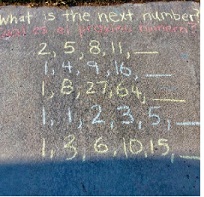
Can you work out what is happening in each of these different sequences? Fin the next number and write the rule.
Friday / Task Five
Login to sumdog and complete the challenge you have been set.
History
This week we have a special piece of History learning linked to VE Day celebrations.
Click the link below to see the activities:
The reading extracts can be found here:
Have fun!
Music
Florence B. Price
Go to the website below and watch Naomi Wilkinson’s video
https://www.bbc.co.uk/teach/ten-pieces/classical-music-florence-price-symphony-no1/z48rscw
 |
Florence Price’s mother was a music teacher and encouraged young Florence to learn the piano. After attending the New England Conservatory of Music, one of the few institutions at the time to …
www.bbc.co.uk
|
Why is Florence B Price considered to be a musical trailblazer?
Watch the video again and practise the Hand Bone Dance with one, then 2 hands.
Now watch the 2nd video. Can you perform the Hand Bone Dance in time to the music?
Art
Click on the link below to find details of this week’s Art Challenge.
MATHS PUZZLE SOLUTIONS
Well done if you attempted any of the maths puzzles for last week. See below for the answers 🙂
Task One

This is one out of many possible solutions! Hopefully this will help you decide if you were correct or not.
Task Two

For this task, the answer just had to be a shape with a number of sides equal to the number of sides in the two added shapes. So – any eight straight-sided shape.
Task Three

This was a tricky one. Some possible solutions are shown above. You can see that not all of these use four 4’s. Depending on how you read the question, you may have tried 44 div by 44 =1, or (4×4) div by 4 div by 4 = 1. If you email in your ideas we will share a few..
Task Four

This was pretty straightforward too.
Circle = 5
Square = 1
Triangle = 2
Task Five
Send in your own puzzles for us to share!
Welcome to ‘The Gallery’. A collection of the work that Year 6 pupils have emailed in.
We thought it would be nice to share some examples of the excellent home learning that has been taking place. Maybe your work could make it onto this page next week?
The class email addresses are:
PENGUINS CLASS: penguinclass@stpeterswaterlooville.hants.sch.uk
SEALS CLASS: sealclass@stpeterswaterlooville.hants.sch.uk
MATHS WORK
From our telephone chats we know many of you have enjoyed making your own smoothies.
Here is Joseph’s own recipe: Seed Extravaganza. Beautifully presented Joseph!

Love the jar mug Joseph!
Here is Islwyn’s equally impressive creation, named Pratley’s Passion in honour of his teacher!

ENGLISH
There has been a good range of English work submitted, all of which has been well planned and thought through. Keep up the good work!

Josh shows a solid understanding of Sophie’s thoughts and feelings in this diary entry.

A letter from Sophie by Siyon.

Josh sent in this explanation of how to ‘free solo’ a rock face. Sorry we cannot make it any larger.
Joseph sent in his Rooftoppers book review; he then had to answer more questions posed by his parents!

Well done Joseph for answering these questions.GEOGRAPHY
Many of you have been enjoying the topic work. Here are a few examples:

We love the way that Hayden has incorporated the different flags into his map of South America.
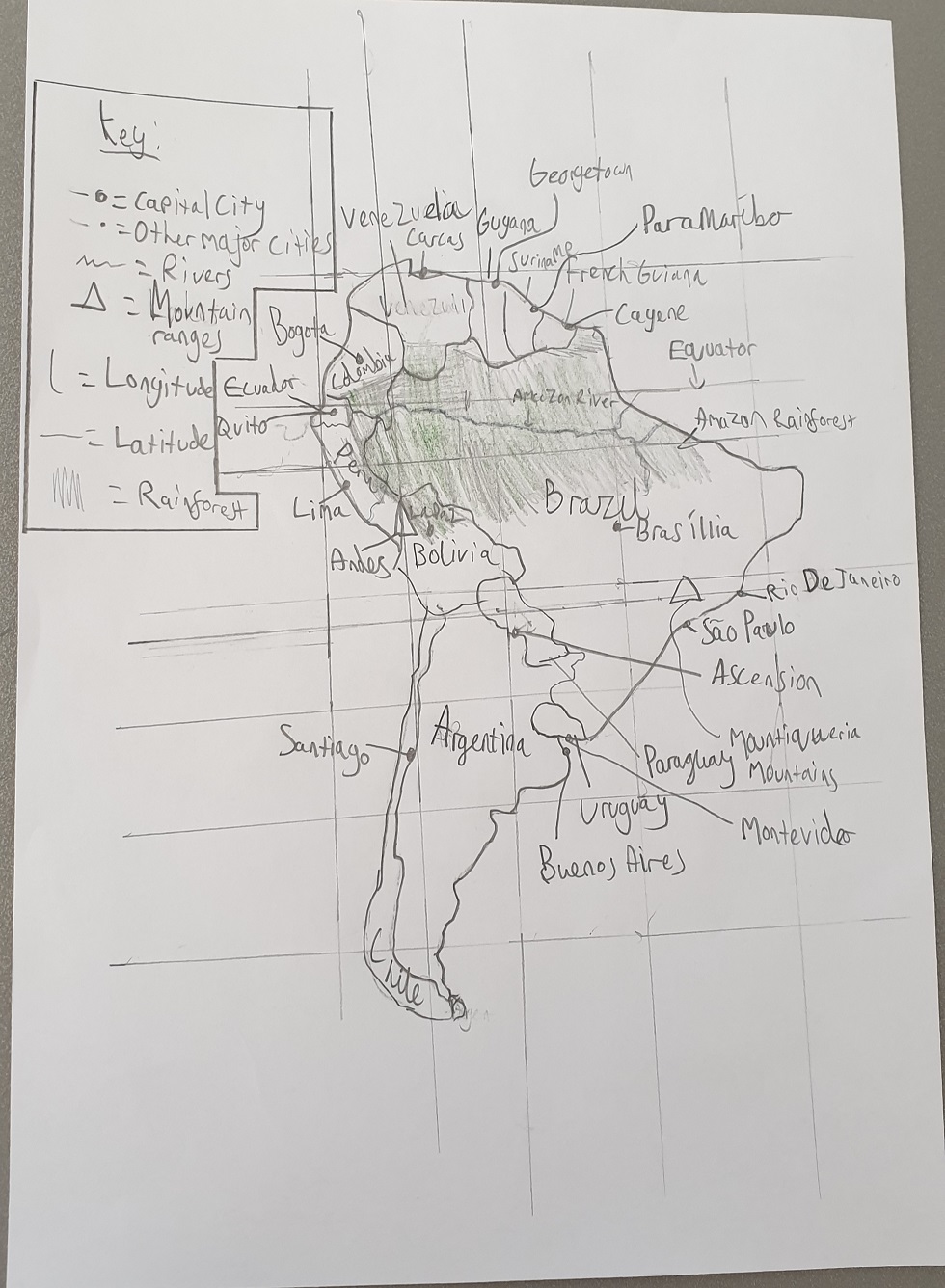
A very detailed map from Kian,

Seren persevered to paint this Brazilian flag!

Josh Smith made this fact file for Brazil
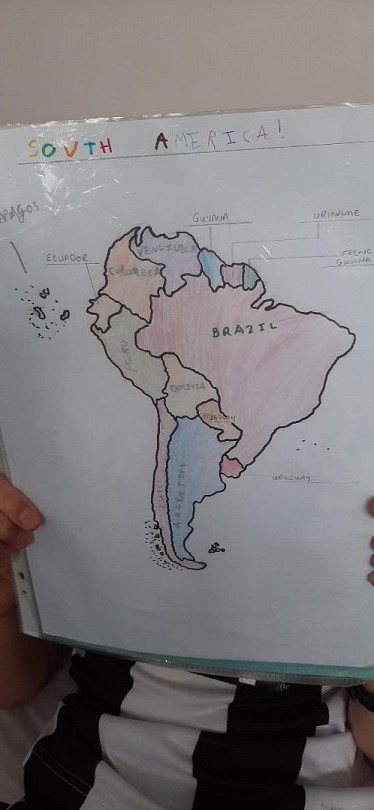
He also drew this map.
SCIENCE
We have also had some lovely science work on adaptation.

Beautiful artwork from Tilly.

Did you know there is a tree kangaroo? Ben does!
COME BACK NEXT WEEK FOR A NEW GALLERY OF WORK!
HOME LEARNING 24 APRIL 2020
Year 6 Home Learning
Week beginning: 27/4/20
Hello year 6! I hope you have been enjoying the sunny weather this week! Mr Land has been challenging himself every other day by going out for his runs in this heat. He says, “The best part of the run is when I return home and my daughter squirts me with the cold water from the garden hose! It feels so rewarding and satisfying!” Have you been keeping active at home? We hope you have! In other news, Mr Pratley has had his hair trimmed by Millie, his fourteen year old daughter and lived to tell the tale! Mrs Moore has been busy too; last Tuesday she took part in the Guide Dogs Virtual Tea Party Guiness World Record Attempt. Over 5000 people took part, smashing the previous record of 500. Here’s Mrs Moore and Tessa enjoying theirs:

Okay children – here is your English Learning for the week. Remember to email in any work you are proud of to the new email address
Guided Reading: (30 mins for each daily activity. Read for enjoyment for 30 mins a day too.)
Monday – Rooftoppers. Read page 66 and 67. Answer the comprehension questions.

Tuesday – Rooftoppers. Read page 68. Answer the comprehension questions.

Wednesday – Read for enjoyment.
Thursday & Friday – Plan and write a book review for Rooftoppers so far. Once you start writing, write at the end of the book review what you think will happen next and what will happen at the end of the book.
Consider the following questions to respond to, for the review:
-What is the story about?
-Was what happened unusual? How? Why? Did it add ‘value’ to the book though? How?
-Who are the main characters? Which do you find most interesting? Why? Are there any characters that you have not met yet but you think you will? Who?
-Have the characters changed throughout the story so far? How?
-Were feelings and attitudes/views described in depth? How? Why was this?
-What has been your favourite moment in the story so far? Why is this?
-Have there been any moments in the story that you think you could have improved? What changes would you have made?
-Have there been any characters in the story that you think you could have improved? What changes to the characters would you have made?
-Do you think the writer had a particular reason for telling this story? If so, what was the reason?
-Did you learn anything from the book about people? What were the elements you learnt?
-What do you think the overall message of the book is?
-Would you recommend it to other children your age or adults? Why is this?
Writing
Monday – Finish your response to the statement and question from last Friday.
Tuesday – Plan an information text about what kit/equipment you would need in order to complete a successful free-solo climb like Alex. Think about the physical pieces of equipment he used and also consider the physical characteristics you would need and the mental qualities you would also need.
Wednesday & Thursday – Write the information text – use your plan from yesterday.
Friday – Re-read your information text for sense and check that you have included a creative introduction and sum up your text (final paragraph) with perhaps what equipment and qualities are MOST important in order to be successful. Think about the physical and mental requirements…
Grammar (2 times a week – 1 hour total)
Please visit www.Satsbootcamp.co.uk
(30 mins) Click on Literacy bootcamp and select a grammar or punctuation skill that you know you need to work on. Explore the Learn, Games and Tests and Quizzes options. Play around with these links and test yourself for your chosen skill!
(30 mins) Go to Practise SATS tests link in the top right corner. Click on the SPAG Short Answers link. Please carry out the SPAG short answers Test 6. It says to give yourself 45 minutes, but you should be fine with 30 mins for the test!
Spellings (15 minutes for three days)
Look, cover, write and check the following words (do this for three days):
physical
condition
bruise
essential
definite
thoroughly
substantial
conscience
Apply into sentences if you are fully confident.
Maths Tasks 24th April
Hello Year 6. For this week’s maths learning I thought you would like a few puzzles to solve which will require you to use your reasoning skills and persevere with a bit of trial and error. Don’t give up if you can’t get it straight away and, if you do think you have the answer, try and prove that you are correct. Remember you can email your solutions in to school. Okay? Here you go…
UPDATE – If you could not read the slides for Sarah’s Smoothies in last week’s work, here are the links to the tasks (you will need to enable flash player). We have had some inspired recipes sent in so far…
Task one: https://teach.conceptuamath.com/client/PremiumMats.html#activity=Gra5020102w
Task two: https://teach.conceptuamath.com/client/PremiumMats.html#activity=Gra5020103w
Task three: https://teach.conceptuamath.com/client/PremiumMats.html#activity=Gra5020104w
Monday/Task One
Remember factors and multiples? A factor is a number that divides into another number with no remainder: 3 is a factor of 12. Multiples are the times tables facts for a given number: 10 is a multiple of 2. For each of the areas A to H in the Venn diagram below, think of a number that can go in it, or say that it is impossible.

Tuesday/ Task Two
Look at the picture additions below. What do you notice? What do you wonder? What can the final shape (?) be? Explain your thinking.

Wednesday/Task 3
Let’s play four 4’s. For this puzzle you have to use four 4’s and any operations to make as many numbers between 1 and 20. So, you could do 4+4 = 8 divided by 4 is 2 add 4 = 6 – that’s four 4’s.

Thursday/ Task 4
You have solved problems like this before. Think – what do you know? What can you find out?
Friday/Task 5
Pick one of the problem styles from the last four days. Create your own version and ask someone in your family to solve it (you could take a photo and send it to lots of family members!)
Science Learning
Family Science Activity – Friday 24th April – STATIC MAGIC
The activity: Make objects move without touching them by charging them with static electricity. ExpeRiment: with different objects to see how static electricity affects them. Learn about charged particles like electrons and how things gain or lose charge.
https://www.rigb.org/families/experimental/static-magic – for a video clip about the experiment and a full version of the activity information sheet.
What you will need:
• A balloon • A cotton towel or T-shirt or a woolly jumper • Some scrap paper • A paper/plastic drinking straw (optional) • An empty 500ml plastic drinks bottle (optional) • A hard plastic comb or ruler (optional) • Other household objects to test.
What to do:
- Charge up a balloon and try picking up scraps of paper with it.
- Investigate whether the amount you rub the balloon affects how much paper it can pick up.
- Investigate whether the size of the scraps of paper makes a difference.
- Find out how close you have to be to the paper before the balloon makes it move.
- Try bending a stream of water like Hector does in the video.
- Try balancing a straw on top of a bottle lid and seeing if you can make it spin like in the video.
- Find out which objects are attracted to the charged up balloon and which are repelled by it.
- Try holding a charged balloon near your hair or your skin.
Going Further:
Try rolling an empty soft drink can along the ground using a charged up balloon http://bit.ly/StaticCanRoll
Try lighting up a fluorescent lightbulb with a charged up balloon – as described here: http://bit.ly/LightBulbBalloon
Try tying two balloons to strings and seeing if you can charge them up with static electricity then hang them up so they repel each other.
Read more about static electricity http://bit.ly/ MoreStaticScience
HAVE FUN!
Music
Steve Reich and Music for 18 Musicians
Go to the website below and watch Naomi Wilkinson’s video about Steve Reich. Try to answer her questions and join in with the activities she sets.
https://www.bbc.co.uk/teach/ten-pieces/classical-music-steve-reich-music-for-18-musicians/zk44y9q
Can you create your own short rhythmic pattern (motif)?
What could you play it on?
Can other people in your family create their own and can you play them at the same time?
Art
Art Challenge: UNDER THE SEA
The title for your art this week is ‘Under the Sea’. This can take the form of a drawing, a painting, a sculpture, a collage or anything else that you would like to create. As always, I’m sure you will impress me with your creativity!
Here are some ideas

Welcome back!
Welcome back to some more enjoyable home learning activities for Year 6. All the staff team hope that you and your families are well and enjoyed the wonderful weather over the Easter break. Scroll down to find out what we would like you to achieve this week. Of course, if you would like to take photos of your work, or complete your work on a computer and email it in to the school for us to see please do so.
Maths
Visit www.sumdog.com and practise finding percentages and your 7,8,9 and 12 times tables.
Brush up on your skills with fractions by completing 3 tasks that have been set for you on MyMaths. Remember – you can complete the lesson first if you are feeling a little rusty.
Extra Maths Challenge.
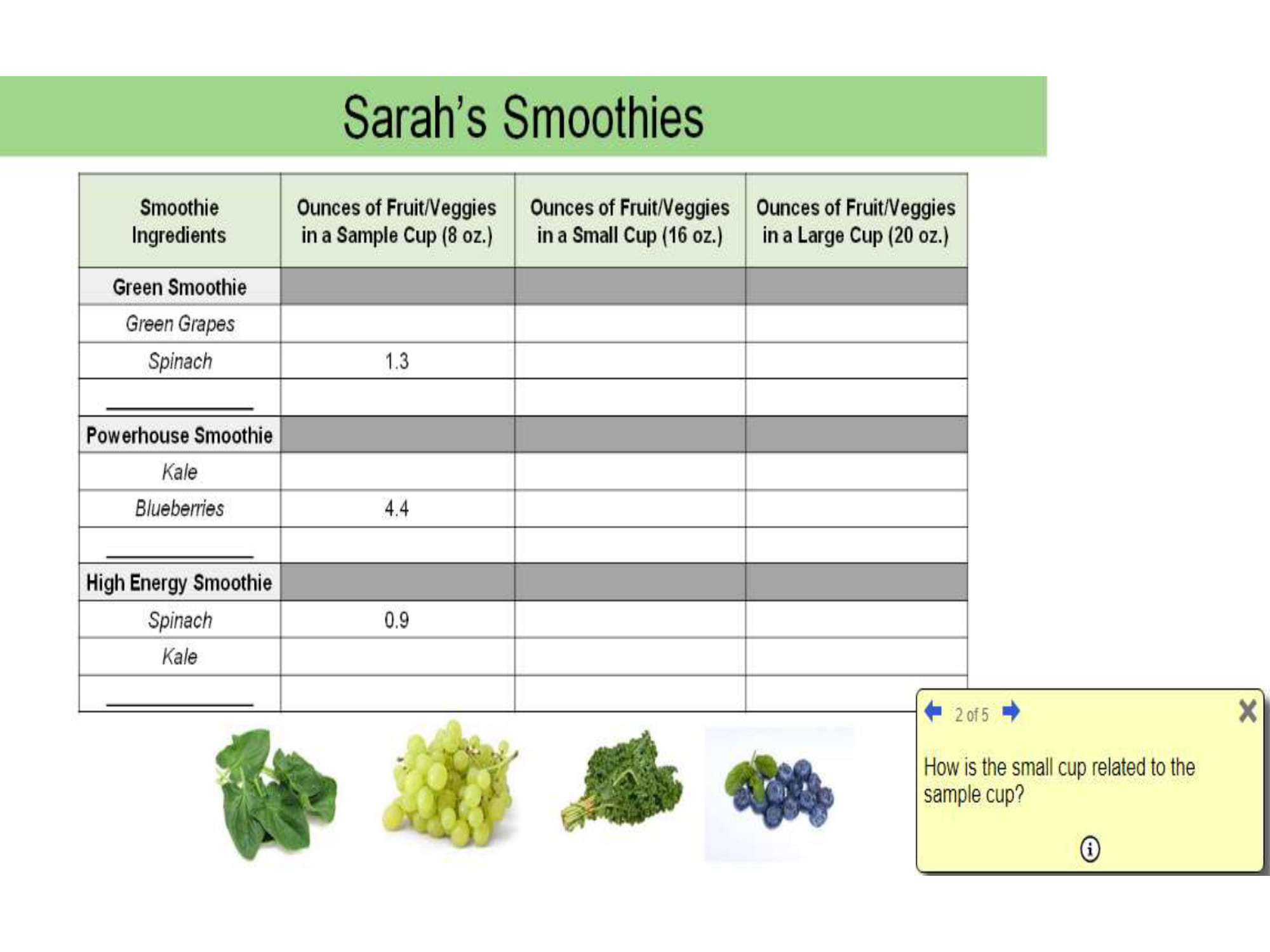
If you are missing your maths learning, why not have a go at the maths challenge below? The slides talk you through the problem. You will be able to create your own smoothie recipe in task 3. Maybe you could design your own packaging and list the quantities of each ingredient? We would enjoy seeing your work if you want to email it in to school.
Update – some of the slides may appear a little blurry. If so, here are links to tasks 1,2 and 3 (you will need to enable flash)
Task one: https://teach.conceptuamath.com/client/PremiumMats.html#activity=Gra5020102w
Task two: https://teach.conceptuamath.com/client/PremiumMats.html#activity=Gra5020103w
Task three: https://teach.conceptuamath.com/client/PremiumMats.html#activity=Gra5020104w
Sharon’s Smoothies – Task One


Maybe you could make this table in a book or on a computer?
Sarah’s Smoothies Task 2




Sharon’s Smoothies Task 3


ENGLISH LEARNING
Guided Reading (Allocated time for task = 30 mins per day; Reading for enjoyment = 30 mins per day)
Monday – (Planning the 6mark answer.) Look at the ‘Alex on the wall’ planning sheet that you have in the writing section of your book. (This sheet has the picture of Alex and Cedar in the middle of it.) At the bottom it is entitled, Guided Reading: Extension’. On Tuesday, you will answer this 6mark question, using evidence and impressions from the film that you watched before Easter. But today you will do the following:
Re-watch the film at least twice to really be able to sense the relationship between the two friends, and make notes around the sheet of this. Really, really try to get into the mind of Alex and how he must view Cedar, and likewise for Cedar’s view of his relationship towards Alex. We know they are friends. We know they must have a ‘special’ relationship, but find other ways to explain and show this. What other synonym words and phrases can you think of that really SHOW the EXTENT of their friendship. THINK – what is the worst case scenario that they could encounter? How would that make each of them feel?
Tuesday – Now, answer the 6mark question from Monday. Use two or three paragraphs to section your thinking. Remember to use evidence from the film to support your impression.
Wednesday – Rooftoppers – read pages 64 – 65. Respond to the questions in your book.

Thursday – Read pages 59 – 63. Respond to the questions in your book.


Friday – Write a set of instructions or an explanation text:
‘How to stay safe at a train station when with your family.’
Include an introduction explaining why this would be of importance and give a summary of the main points you consider to be most important. DO NOT go into these points in detail though – remember to tease the reader and make them want to read on!
Paragraph 2 and 3 should be explaining how to stay safe when you are at a train station.
The final paragraph should close your points, recap the main points AND write about the impact this will have for people in the future. Do you also have any top tips?
Writing (1 hour a day)
Monday – Finish writing your Alex Honnold suspense story. Remember to be editing as you write and re-reading for sense AND checking that you have been using commas to separate your subordinate clauses and your main clauses. If you have opened a sentence using a subordinate clause (a clause that doesn’t make sense on its own) then you will need a comma to separate that clause with your main clause (a clause that does make sense on its own) that follows.
Tuesday – Read this statement below:
‘Alex is careless and reckless with his life when he climbs mountain faces without ropes. He does not think about his family, friends and the consequences involved.’
Only plan your response today.
Plan a developed response to this statement above, making notes about your views of the statement and justify your views using your own opinions. Make multiple points and support them with any evidence from the film OR any of your own opinions, obviously. Write half a page when planning this.
Wednesday – Now, write your developed response to the statement from yesterday. Include paragraphs to section your thinking. This should be about a page in length. Refer to your plan that you made yesterday.
Thursday – What was the role of Cedar in the preparation of Alex’s climb up El Sendero Luminoso? Re-watch the film and make notes about what Cedar had to do. Also, what was Cedar’s role when they were resting the night before? Did they just talk about nothing, or might there have been specific discussions taking place? Explain these ideas in note-form only, for today. Explain and justify why you think Cedar would have had to do the things he did in the days and moments before Alex’s big climb. What kind of person would Alex have wanted there with him? An anxious and intense person?
Friday – You have today and next Monday to respond to the statement and subsequent question below, so do not rush:
‘The role of Cedar was vital and important in order for Alex to climb El Sendero Luminoso successfully. What things did Cedar do that showed his role was important and vital?’ THINK – How did Cedar show this? What things did he do that ‘directly’ and ‘indirectly’ helped Alex succeed? I would watch the film again and jot any thoughts and observations down.
Start writing! You have Monday to finish this too, so do not rush.
Grammar (3 times a week – 1 ½ hours total) Please visit www.Satsbootcamp.co.uk
(30 mins) Click on Literacy bootcamp and select a grammar or punctuation skill that you know you need to work on. Practise makes permanence!
Explore the Learn, Games and Tests and Quizzes options. Play around with these links and test yourself for your chosen skill!
(30 mins) Then, go to Practise SATS tests link in the top right corner. Click on the SPAG Short Answers link. Please carry out the SPAG short answers Test 8. It says to give yourself 45 minutes, but you should be fine with 30 mins for the test!
(30 mins) Go to the Practise SATS tests link in the top right corner. Click on the SPAG Short Answers link. Please carry out the SPAG short answers Test 7. It says to give yourself 45 minutes, but you should be fine with 30 mins for the test!
Spellings (15 minutes every day)
Look, cover, write and check the following words (do this for three days):
technical
potentially
route
vegetation
condition
sub-optimal
slipping
intimidated
slight
feat
(One day) Challenge! What are synonym words or phrases (similar meaning to a word) of: ‘potentially, route, vegetation, sub-optimal, intimidated, slight, feat.’
List them in your book!
(One day) Apply these words into sentences related to Alex’s climb of El Sendero Luminoso.
Friday 17th April 2020 – Religious education
As part of your RE learning and reflection upon Easter, we would like you to complete ONE of the following activities, in order to develop your knowledge of this special time in the Church calendar…
· Design your own Easter Egg and include as many symbols for new life as you can!
· Create a comic strip cartoon of the key events that took place in the Easter story.
· Write a journal that includes the thoughts and feelings of Mary and the disciples, when they had discovered the empty tomb.
· Draw your own Good Friday crucifix and fill it with prayers for Jesus, as well as those around the world who have been working hard and making sacrifices for the good of others.
· Make a prayer station at home, for moments of peaceful reflection. Choose an Easter prayer as part of your worship, from https://cafod.org.uk/Pray/Prayer-resources/Easter-prayers
· Build your own Easter word search and include as many religious key words as you can, e.g. Resurrection, Sacrifice, Miracle, New Life, Tomb.
· Decorate your own Easter postcard with a Biblical image. Record your own Happy Easter message and spread the Good News to one of your friends!
SCIENCE – Adaptations
Research in books or online about a rainforest animal. Draw your chosen creature, label its features and write a short explanation of how it has adapted to the conditions it lives in.
You may also like to try the family science activity below:
Family Science Activity – Friday 17th April 2020
Fizzy Bottle Rockets – click on the links below to view a video and download the information sheet.
https://www.rigb.org/families/experimental/fizzy-bottle-rockets
https://www.rigb.org/docs/fizzybottlerockets_infosheet_v2_0.pdf
Questions to ask children:
When tablet is put in glass of water: What do you think is in the bubbles?
Where do you think the bubbles are coming from?
What do you think would happen if we used more than one tablet? Why?
What do you think would happen if we used warm water? Why?
Before making rocket:
What do you think will happen if we put some tablets and water in this bottle and close the lid? Why?
What things could we change to make the rocket go higher?
Going further:
Experiment with different sizes of bottle and different combinations of water and tablets to find out what combination gives you the highest flying rocket.
Does it matter how many tablets you use?
What about if you break the tablets into smaller pieces?
How does the temperature of the water affect things?
Watch a flame powered bottle rocket: http://bit.ly/FlamingBottleRockets
Learn more about propulsion by building a balloon powered car: http://bit.ly/ BalloonCars
Geography
Where is Brazil? Use an atlas or online world map to draw the outline of the large country of Brazil.You will have done a similar task in Yr 5.
Mark on the following:
- All neighbouring countries.
- The Amazon river.
- Mountain ranges
- Major cities
- Lines of latitude and longitude.
- Any other points that interest you
Art Home Learning
The title for your art this week is ‘NEW LIFE’. You can be as creative as you like. It could be a drawing of yourself as a baby, a baby animal made out of kitchen roll tubes, a photograph of a tree with buds, an Andy Goldsworthy inspired piece of art made out of natural things in your garden or when you have been on a walk. Impress me with your creativity!

Please email your artwork to me:
n.pearson@stpeterswaterlooville.hants.sch.uk
Thank you!
Keep creating and keep safe!
Mrs Pearson
KS2 Music Home Learning – Musical Trailblazers
Friday 17th April
Delia Derbyshire and Doctor Who
Go to the website below and watch Segun Akinola’s video about Delia Derbyshire. https://www.bbc.co.uk/teach/ten-pieces/classical-music-delia-derbyshire-doctor-who-theme/zfh792p
Why was she a musical trailblazer?
Can you use everyday objects to recreate the Doctor Who theme tune?
Challenge-can you play around with your sounds and find a way to record them?
Easter Home Learning Activities
- Create a PowerPoint that includes information about each station of the cross.
- Write prayer booklet, to thank Jesus for His sacrifice and offer prayers of strength and support to those who are suffering.
- Record the thoughts and feelings of Mary in a journal – how would she have felt at this time? Why?
- Make a stained glass window about ONE of the stations of the cross that means the most to you.
- Host a worship session with members of your household. Can you choose a special image or bible passage to use as part of your reflection on the events of Holy Week?
- Write the words ‘Holy Week’ in large bubble writing and include any relevant religious symbols, signs and Holy colours to decorate it with.
- Look up the stations of the cross online and read the Bible story. Can you use drama or role play to re-enact each scene and remember what happened?
- A painting of all of the religious symbols found within this faith? Label what each one is called/used for.
- An information poster including 10 key facts about the religion.
- Write a diary entry for a follower of this faith – what would their day look like and how would they pray?
- Build a place of worship for your chosen faith (e.g. temple, Gurdwara, Mosque)
- Create a piece of music that could be used for prayer by the followers of this religion.
- If you could make a set of rules or commandments for this faith, what would they be?
- Create a set of top trump, ‘snap’ or ‘pairs’ cards about this faith, to play with your family members.