Twas the Night Before Christmas Year 5
A Visit from St. Nicholas
‘Twas the night before Christmas, when all through the house
Not a creature was stirring, not even a mouse;
The stockings were hung by the chimney with care,
In hopes that St. Nicholas soon would be there;
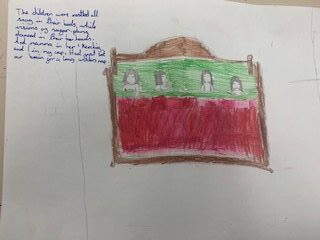
The children were nestled all snug in their beds;
While visions of sugar-plums danced in their heads;
And mamma in her ‘kerchief, and I in my cap,
Had just settled our brains for a long winter’s nap,
When out on the lawn there arose such a clatter,
I sprang from my bed to see what was the matter.
Away to the window I flew like a flash,
Tore open the shutters and threw up the sash.
The moon on the breast of the new-fallen snow,
Gave a lustre of midday to objects below,
When what to my wondering eyes did appear,
But a miniature sleigh and eight tiny rein-deer,
With a little old driver so lively and quick,
I knew in a moment he must be St. Nick.
More rapid than eagles his coursers they came,
And he whistled, and shouted, and called them by name:
“Now, Dasher! now, Dancer! now Prancer and Vixen!
On, Comet! on, Cupid! on, Donder and Blitzen!
To the top of the porch! to the top of the wall!
Now dash away! dash away! dash away all!”
As leaves that before the wild hurricane fly,
When they meet with an obstacle, mount to the sky;
So up to the housetop the coursers they flew
With the sleigh full of toys, and St. Nicholas too—
And then, in a twinkling, I heard on the roof
The prancing and pawing of each little hoof.
As I drew in my head, and was turning around,
Down the chimney St. Nicholas came with a bound.
He was dressed all in fur, from his head to his foot,
And his clothes were all tarnished with ashes and soot;
A bundle of toys he had flung on his back,
And he looked like a pedler just opening his pack.
His eyes—how they twinkled! his dimples, how merry!
His cheeks were like roses, his nose like a cherry!
His droll little mouth was drawn up like a bow,
And the beard on his chin was as white as the snow;
The stump of a pipe he held tight in his teeth,
And the smoke, it encircled his head like a wreath;
He had a broad face and a little round belly
That shook when he laughed, like a bowl full of jelly.
He was chubby and plump, a right jolly old elf,
And I laughed when I saw him, in spite of myself;
A wink of his eye and a twist of his head
Soon gave me to know I had nothing to dread;
He spoke not a word, but went straight to his work,
And filled all the stockings; then turned with a jerk,
And laying his finger aside of his nose,
And giving a nod, up the chimney he rose;
He sprang to his sleigh, to his team gave a whistle,
And away they all flew like the down of a thistle.
But I heard him exclaim, ere he drove out of sight—
“Happy Christmas to all, and to all a good night!”
The children read through this iconic Christmas poem before selecting part of it to illustrate. Can you see what part of the poem each illustrator has chosen?



Family Christmas Workshops
We had a fun couple of days working with children and their families creating festive crafts and making wonderful memories. The families used our ‘infamous’ arts and crafts buffet to find all the bits and pieces to embelish their creations.
Reception families created Christmas wreaths and festive cork coasters.


Year 3 created these fantastic ice skaters on a pond and snow hillslope Christmas cards


Year 5 children and their families created these stunning Paper lanterns and Stocking Christmas cards.
Reception create Shape Snowmen
Our Reception children were learning about different 2D shapes and we created these wonderful snowmen using a variety of them. Can you count how many circles, triangles, squares and rectangles each snowman has?


GAP Year 6 – I am a protector and Keith Haring
We used this book as inspiration for our art project:

We Are Water Protectors was written by Carole Lindstrom, who is part of the INDIGENOUS Ojibwe people. The main theme of this reading is the ongoing issues surrounding the Dakota pipeline and what that means to the local indigenous communities. The story goes through the importance of protecting our environment, traditions and community. Michaela Goade brings each page to life with sweeping landscapes, designs and colours that swirl and melt together.
This personal expression lesson invites our children to ponder the importance of protecting what matters to them, whether that is a natural resource, living thing or something important to our history. The children created a folded concertina which unified a variety of drawings to represent what they have chosen to protect.


We took inspiration from the American artist and sculptor Keith Haring and created these tin foil people. We then glued them onto card and drew in their shadow. Look at all the different poses the children created.


GAP Year 5 – Statue of Liberty

The STATUE OF LIBERTY stands on Liberty Island in New York City harbour. She has stood as a symbol of the UNITED STATES since it the statue’s dedication in 1886. Sculpted by Frédéric Auguste Bartholdi, the statue was a friendship gift to the United States from the French. In her right hand she raises a torch which is a symbol of Liberty’s focus on enlightenment and progress, and in her left hand she carries a tablet inscribed with July 4, 1776 which is the day the United States declared independence.
The children drew their pictures, using Sharpies and then used a variety of media, including watercolours, felt-tips and coloured pencils to colour them. They really took their time and focused to get the *patina colour of the statue just right! As you can see, the children did a fantastic job and I couldn’t be prouder of them!


*PATINA: a green or brown film on the surface of bronze or similar metals, produced by oxidation over a long period.
GAP Year 4 – The Grand Canyon and Canadian Mounties.

The GRAND CANYON is a giant canyon located in ARIZONA in the United States. Recognised as one of the Seven Wonders of the World, the Grand Canyon has taken over two billion years to form. Rock has slowly been washed away by the COLORADO RIVER, creating the steep canyon walls, through a process called EROSION. Year after year, the Colorado River has made the canyon deeper. Due to erosion, there are over 40 sedimentary layers of rock in the Grand Canyon, many of which create the colourful layers that make up the canyon walls.


Thc children laernt about the life of Canadian Mounties before creating these impressive portraits of them. I think they look fab!


GAP Year 3 The Sonoran Desert

The SONORAN DESERT is a North American desert that covers large parts of the SOUTHWEST in the United States and Northwestern parts of Mexico. The Sonoran Desert is especially dry and warm compared to other North American deserts and while it might seem surprising that many plants and animals live in this desert, some really thrive. The SAGUARO, a type of cactus that only grows in the Sonoran Desert, can actually live to be over 150 years old.


GAP Year 2 – Bisons and Canadian fishing boats

BISON, not to be confused with buffalo which are found throughout Asia and Africa, are found mostly in North America. Bison are a sacred animal to Native Americans who would hunt the bison, using every part of it for their basic food, clothing and shelter needs. After nearly being hunted to extinction by settlers, bison herds were preserved and are no longer considered an endangered species.
The children learnt about the habitat of the bisons and then painted their landscapes. They drew their bison with oil pastel and sponge painted it to create the fur texture.
I think you will agree that they did an amazing job!


We learnt about the Canadian fishing industry and the small towns that rely on fishing for their economy. The children then used watercolours and oil pastels to create these stunning fishing boats.


GAP Year 1 Sonoran Desert Tortoise, USA Bald Eagle…..and COSY CAT!
The desert tortoise is a species of tortoise in the family Testudinidae. The species is native to the Sonoran Deserts of the southwestern United States and northwestern Mexico. The desert tortoise is the official state reptile in California and Nevada.
The desert tortoise lives about 50 to 80 years; it grows slowly and generally has a low reproductive rate. It spends most of its time in burrows, rock shelters, and pallets to regulate body temperature and reduce water loss. It is most active after seasonal rains and is inactive during most of the year.


The children learnt about the American artist Ryan Conners and how she loves to draw cats wrapped up warmly and drinking hot drinks. The children used collage to create their own COSY CATS. Do you have a favourite? If so, why? It’s hard to choose as they are all fabulous!


GAP – Reception – Arctic polar bears & Thanksgiving Pumpkins
ABOUT ARCTIC ANIMALS
The ARCTIC is a region that covers the northernmost part of Earth. Northern CANADA is included in this usually cold, snow and ice-covered land. Arctic animals are special because they can live where
the summer is very short and the winter is long, dark and cold.
TED HARRISON (1925-2015) was a Canadian artist whose landscape paintings
were influenced by his surroundings in Canada. The children created their own polar bear and landscape inspired by this amazing artist.


Thanksgiving is an American and Canadian holiday. It is celebrated to give thanks for the harvest and for the year ahead.
Today, Thanksgiving is celebrated in many countries around the world.
The children did observational drawings of pumpkins and coloured them using chalk pastels. As you can see, they did an amazing job!


